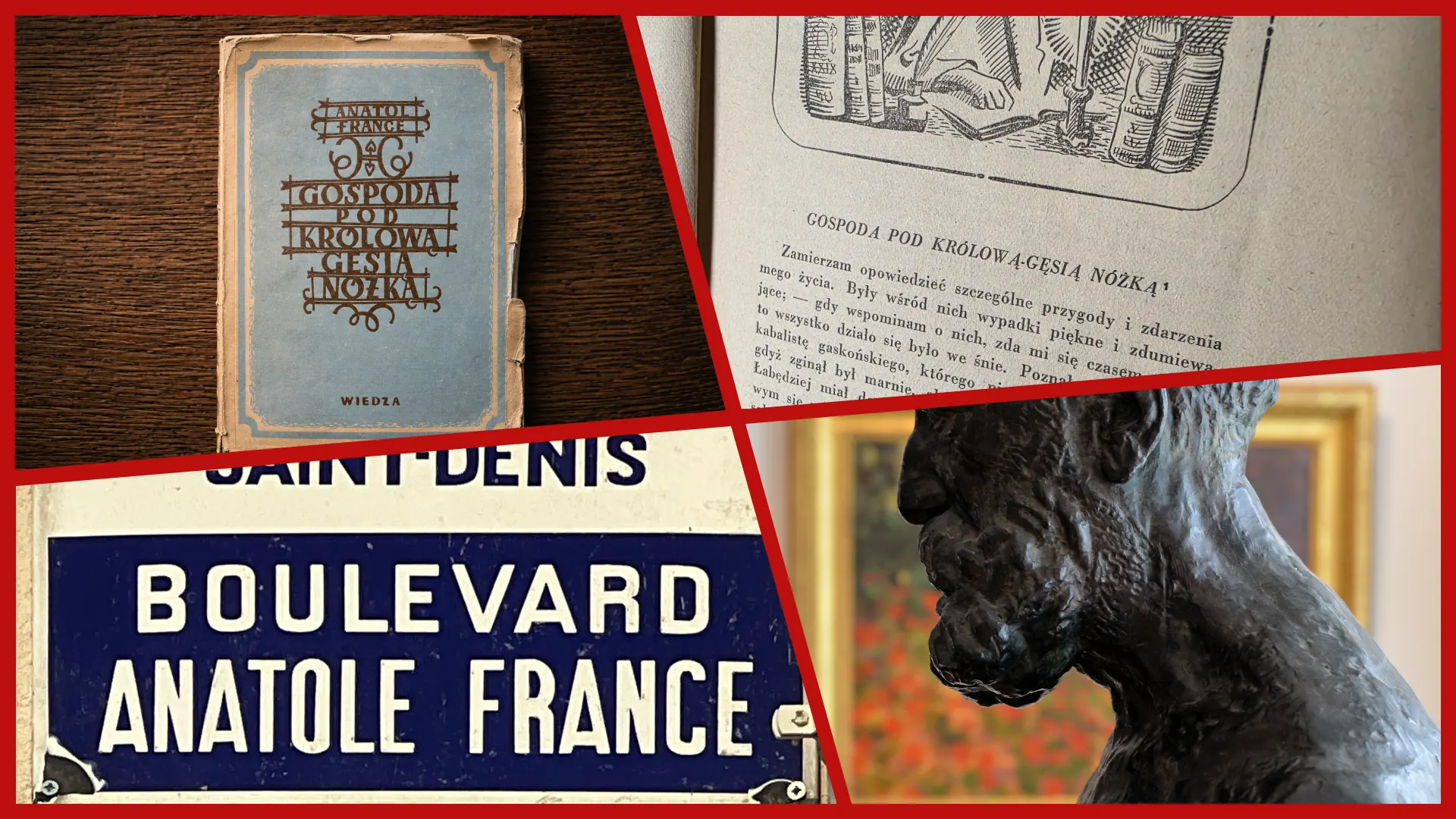
At the Sign of the Reine Pédauque, or the pleasures of reading bygone worlds
“…forgive me, Your Eminence, for having to die in your presence!
— Not at all, not at all; do not let me disturb you — His Eminence replied kindly.”
I remember my late friend who, whenever we talked about books, would repeat: “Read Anatole France. Read Anatole France.” And although this writer sat on the bench for a long time, in the end he too was caught by my reading.
The book swept me away immediately!
Above all, it is written in beautiful, quite wonderful language. In the presence of such an excellent text, even the fact that we are reading it in Polish translation recedes into the background. What comes to the fore instead is the feeling that we are dealing with an integral work created by both writer and translator — complete, self-contained and whole, something that should be received precisely as a literary unity.
The characters who appear here, even those from the lower social classes, speak in refined and colourful language. I would venture to say that this is the so-called “literary language” we were taught about at school, displayed here in all its splendour.
And it is precisely this question that I would like to consider for a while.
I do not know French well enough to identify French archaisms with sufficient precision, but I believe that we can distinguish here something like three linguistic and cultural layers.
1. Anatole France completed the novel in 1892. The differences between the language of more than a century ago and contemporary language are not difficult to notice when we compare any book written at the end of the nineteenth century with a modern text. No great philological apparatus is required — the reader’s ear is enough.
2. Although fin-de-siècle French may already present a considerable puzzle even to a French reader, France sets the action of the novel in the eighteenth century and therefore uses what is known as archaic or historical stylisation — and, it should be added, stylisation from the perspective of an author writing at the end of the nineteenth century.
This is not insignificant, because the very question of making language appear old from the perspective of different historical periods is a fascinating subject of study. Arising both from objective historical reality and from the material of literature itself, this device opens up a field in which language becomes an expression of the culture we encounter on the pages of the novel.
To me — and also as a way of bringing the narrative form closer to potential readers of this review — the book resembles a cross between Cervantes’s Don Quixote and Potocki’s The Manuscript Found in Saragossa. We therefore meet a whole constellation of colourful figures: sages, philosophers, scholars, rogues, brawlers, priests, monks, alchemists, simpletons, hot-tempered noblemen, flighty young women, dignified matrons, drunkards, libertines, innkeepers and merchants. Although they do not all receive equal space, the author treats this entire gathering with equal attention, care and even love. The characters are touching, endearing, worthy of concern or compassion. If the author himself loves them, how could the reader fail to love them and sympathise with them?
Although the novel has many virtues, for me its greatest is the enormous amount of humour with which it was written. If it had to be located more precisely in terms of genre, we would be dealing with a novel of the following kinds: #picaresque, #adventure, #philosophical, #romance. These four hashtags capture its atmosphere best. Anyone who enjoys such territories will find a book for them here. And anyone who does not — perhaps because a romantic plot puts them off — should read France all the more, because a love story handled in the manner found in this novel may well win them over.
Apart from its humorous and adventurous layer, the plot contains what I value most in novels: philosophical, ideological and erudite digressions. All this is presented with the proper distance, elegance and grace. Not for a moment do we feel that the book is secretly attempting to indoctrinate us. The disputes and tirades of Abbé Coignard are masterly passages of this kind of literature. One curiosity proved particularly close to me: my own parish, dedicated to Saint Catherine of Alexandria, apparently has a patron saint who never existed, as this passage, spoken in Abbé Coignard’s learned words, makes emphatically clear: “One reads, in Nicole Gilles* and in Pasquier**, that St. Catherine and St. Margaret appeared to her [Joan of Arc]. But certainly it was not God who sent them, for there is no one, however little learned or pious, but knows that Margaret and Catherine were invented by the Byzantine monks whose extravagant and barbarous imaginings have defiled the Martyrology.”
* https://fr.wikipedia.org/wiki/Nicole_Gilles
** https://en.wikipedia.org/wiki/%C3%89tienne_Pasquier
There are more such moments in the book. France plays with erudition, but at the same time shows that, for his characters, history, theology, philology and everyday life form one great material of conversation.
The historical layer of the novel is also immense. Interestingly, we encounter not only the period in which the action takes place, the eighteenth century, but also earlier times constantly invoked in dialogue: antiquity, the Middle Ages, the Renaissance, the humanist tradition, the history of heresy, alchemy, libraries and scholars. One might say that the novel opens before us a past perfect tense: a past seen through the eyes of people who have themselves already become the past for us.
Yet it is above all the represented eighteenth-century world that offers an enormous variety of cultural details. We learn, for instance, from descriptions of dining customs that people eating meat would scatter bones around the room wherever they pleased, because leaving gnawed bones on the table was considered improper and in bad taste; that many kinds of birds were eaten — from ordinary geese to fieldfares, quails, thrushes and larks (poor little birds); that huge quantities of grease and powder were applied to hair or wigs, with the powder falling onto the shoulders or floating around a moving person; and that feet were turned outwards, which was regarded as part of an elegant posture. When looking at portraits from the period today, one can indeed notice this manner of posing. We also encounter old card games, played by the characters with great enthusiasm: piquet, Bohemian tarot, ombre and lamber. Their rules appear extremely complicated, and the characters repeatedly lose their way in them with indescribable pleasure. A French cultural landscape could not, of course, exist without wines, remarks on the benefits of drinking them, methods of cultivating vines and concern for the fruit. All this delightful background of the period, once one is willing to enter it, becomes a succession of inviting doors. Every detail is a contribution, an encouragement, an introduction to the exploration of the cultures of former ages.
3. The book passes through the filter of Polish translation, and this is its third veil, one that deserves particular attention. The quality of the translation is something that becomes strikingly obvious from the very first sentence. Literary criticism has the concept of a “congenial translation” — a translation that becomes an autonomous work of art in the new language. The Polish translator of At the Sign of the Reine Pédauque was Jan Sten. His version certainly deserves that name.
What determines this?
Anatole France wrote in a distinctive French stylised after the language of the eighteenth century — full of elegance, but also of earthiness. My intuition as an amateur in Romance languages is that Sten did not translate this language mechanically. Instead, he created his own Polish equivalent of that stylisation. He used expressions, rhythms and structures drawn from older Polish, which makes his version sound so natural that one has the impression of encountering not a translation, but an original work written on the Vistula. Hence we find such words as “zasromało”, “kocz”, “trybulacje” and “pluderki”, which in turn reveal fascinating territories of old Polish culture. Although many people translated France, after reading Sten I would venture to say that a new translation might prove something bizarre, futuristic or entirely catastrophic.
I am not arguing that the classics should never be translated anew, but in this case the bar has been set extraordinarily high.
Information about Sten can of course be found easily, but one particularly striking fact in his biography is that translation was a secondary, almost hobby-like occupation for him. Jan Sten, whose real name was Ludwik Bruner, was trained as a chemist, worked as an academic teacher and wrote scientific works in chemistry. From this perspective, not only the quality of his translations but also the enormous amount of labour he must have invested in them is astonishing. During a short life — he died at only forty-two — he managed to accomplish truly impressive things. A genuinely versatile, brilliant and titanic worker.
It is, incidentally, a great pity that he did not live to translate France’s highly controversial work on Joan of Arc. In Poland it is still waiting for its translator.
I like old books that carry a history of their own. The edition I read dates from 1948 and, as befits an old book, contains subtle graphic decoration. Every chapter begins with an illustration. According to the publisher, their author was Mieczysław Jurgielewicz. The name immediately reminded me of Irena Jurgielewiczowa, author of That Stranger, a book familiar from school and once compulsory reading in the sixth grade. The association proved correct: Mieczysław Jurgielewicz and Irena Jurgielewiczowa were married.
Mieczysław Jurgielewicz himself, born in 1900, was a painter and graphic artist. Although he served in the Home Army during the war, he managed to survive the Stalinist period and establish himself with his work on the Polish and European art scenes. But that is already a subject for another chapter. Looking through Jurgielewicz’s works available online, one immediately notices his characteristic sharp line, which he also used in the illustrations for this book.
The book was published by the “Wiedza” Publishing Cooperative, connected with the tradition of the Polish Socialist Party. Between the end of the war and the beginning of socialist realism in Polish culture, it managed to publish a broad selection of outstanding classics. France, because of his commitment to the European left, was a relatively safe author for later communist publishers, and his works were reissued throughout the entire period of the Polish People’s Republic. Significantly, interest in this Nobel laureate began to decline markedly in Poland after 1989.
I will not, however, investigate here the strength of Anatole France’s own left-wing convictions, because that is not what this text is about. It is about a charming book which, I hope, this description will encourage readers to discover.
As I have tried to show, a single book of this kind can be read on many levels: as a picaresque novel, a philosophical novel, a romance, a display of stylistic imitation, a masterpiece of translation and a gateway to an earlier culture. What I have written here is no more than a contribution. But perhaps this is how truly living books reveal themselves: after reading them, the world does not close — it opens further doors.
Quoted from Mrs Wilfrid Jackson’s English translation, published as At the Sign of the Reine Pédauque