Hydra — a narrative with too many heads
This book is a narrative tragedy. It sprawls chaotically in every direction. The authors completely lose control of the material they have gathered and are trying to present. The text is like a blob squeezed in the hand, forcing its way between the fingers with no order or structure. Almost every sentence opens up a new thought or thesis which is then never developed. It feels as though the authors had a pile of index cards covered with various observations and simply arranged them into a text, sorting them only slightly, without giving the whole thing any real flow, clarity or coherence.
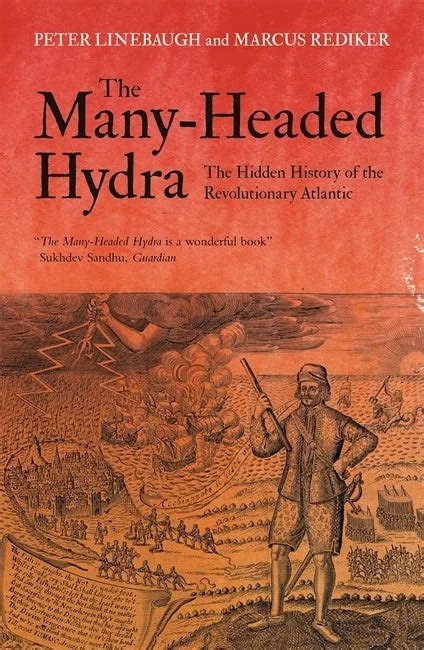
The subject, the idea, the title and the cover are — of course — extremely enticing. And yet, paraphrasing the familiar saying, one should perhaps warn: “Don’t judge a book by its title.” I have no idea why it turned out this way. Judging from the information about the authors, they are serious people holding serious academic positions, but perhaps conveying knowledge in book form is simply not their strongest skill. Well, nobody has to be good at everything. They may be excellent at research or at other forms of academic and teaching work, but when faced with a long continuous text they clearly lose control of it. Unfortunately, there are two authors, so both of them have to take the blame, because how am I supposed to know who is responsible for what? With a publication of this size they probably also worked with assistants and editors, but their names are on the cover, and they are ultimately responsible for the final shape of the argument.
A typical example: the authors construct a subsection of, say, six pages and then, in the final paragraph, move on to a conclusion which barely follows from what came before, or is only loosely connected with it. It is as though they desperately want to make an important point but cannot lead the reader towards it by any logical, sequential route. It is hard work to read. Entire chapters are devoted to analysing biblical quotations — well, I admit that this was not exactly what I expected from the title. I am not even sure whether one can speak of wasted potential here, because I am not convinced that such a vast subject can be contained within a single coherent volume at all. Perhaps the material itself fought back and told the authors: “You shall not pass this way.”
The authors travel across time and space, jumping between continents. We encounter pirates, enslaved people, servants, aristocrats, prisoners, prostitutes, merchants, robbers, bishops, sectarians, sailors, soldiers, the guilty and the innocent. The book attempts to give all these people a voice and draw our attention to them. Unfortunately, in my view, it does not succeed.
Criticising this book is coming to me far too easily, and I genuinely prefer writing positive reviews to ripping into someone, so I will try to extract something good from it. Well… the hardback cover. (Joke :)) The book attempts to describe the blood-soaked beginnings of capitalism from the seventeenth century onward — or, more precisely, its second actively expanding branch, the first having been the Italian republics — namely Atlantic colonialism and the slave trade, shown against the background of the religious conflicts of the period. It can certainly teach the reader that the people and movements described in the book existed at all. In that sense, it may serve as a starting point for further exploration. As for the fact that the period was marked by terror, lawlessness, murder, exploitation, inhuman labour and omnipresent violence, any reader with even an average familiarity with history already knows that.
One genuine advantage of the publication is the collection of rare engravings, of which there are quite a few. And here — surprisingly, wow — they actually correspond to the content of the individual chapters! And that is probably it.
My initial reflections on whether this was an academic or a popular-history book gradually became irrelevant — precisely because of the shortcomings of the narration. Formally, it is an academic publication, since it meets the requirements of that kind of writing. Yet because it was published in Poland by Wydawnictwo Krytyki Politycznej, one might have expected at least some degree of accessibility. I am not claiming that books from this publisher are easy, but it is not a strictly academic press either. Well, I am a little sad that such an intriguingly framed subject was presented in a form that makes it so difficult to explore.