Literary and Pictorial Allusions in Woody Allen’s “Coup de chance”
Well, yes: another wonderful Allen film captivates from its very first minutes. Admittedly, it is no longer entirely new, since it dates from 2023, but so far it remains the director’s most recent film. Most recent does not mean worst, although I am familiar with the argument that Allen once made great films and now merely trades on his former brilliance. I suspect, however, that people who speak this way are not his true admirers, but simply treat him like any other director, with analytical detachment. Unfortunately, I shall not be objective here, because Allen is one of my favourite filmmakers and I personally regard him as a genius — and in my inner world very few artists deserve that name. I place him on a pedestal with complete conviction, not only within cinema but within art as a whole, probably because of the effect his work has on me. One would like to say that a work of art exists objectively as a product of the human mind, yet even this statement requires a small reservation: what is art to one person may not necessarily be art to another. It is precisely here that the subjective, individual nature of its reception becomes most apparent.
Above all, I find his works extraordinarily coherent. By this I do not mean that all his films tell their stories in a similar way, but that each film possesses its own internal coherence. Everything works together: screenplay, music, production design and acting. From the opening credits, characteristic jazz phrases establish the tone of the entire performance; they return throughout the film and bind it into a single whole. I must admit that these jazz passages simply undo me — from the very first moments I am won over by the narrative and completely disarmed by it; I know that I am entering the world of a Woody Allen film. In his screenplays, even the most episodic character receives a distinct personality and at least a brief opportunity to exist: if not through direct speech, then through a miniature backstory supplied in passing. The framing, casting and performances reveal the hand of a master who knows how to guide actors so that they do not break out of the Allen style but become an integral part of it, while retaining their own individuality. One is tempted to say that, in a sense, they all play Allen himself — his rhythm of speech, nervousness, irony and way of looking at the world. When he still appeared in his own films, the actors he chose — often the same ones, such as Alan Alda, Tony Roberts or Dianne Wiest, or performers representing a particular type of personality and appearance, such as Jesse Eisenberg — became his equal partners rather than mere executors of roles written for them.
Another essential element is what might be called subtle wit — understated, often barely signalled and not perceptible to everyone. Unfortunately, or perhaps fortunately, it demands a certain sensitivity, knowledge and intellectual agility from the viewer, becoming a kind of filter: one may aspire to this mode of reading, but not everyone truly succeeds in attaining it. This characteristic humour forms part of such a distinctive cinematic language that, over time, it became a model others tried to analyse and imitate — fictional characters and real artists alike. The example emotionally closest to me is Ed from Northern Exposure, who wanted to make films like Woody Allen and, among the eccentric inhabitants of the Alaskan wilderness, hardly needed to direct his actors at all. In the real world, many filmmakers have likewise tried to capture this particular mode of expression and build their own narratives from it. One of the finest contemporary examples, in my view, is The White Lotus — a series clearly permeated by Allen, without being a simple imitation of his cinema.
These are merely shorthand thoughts and subjects for separate essays, for which I shall probably no longer have enough life. It is therefore time to abandon these digressions and turn to the film itself.
In Coup de chance (2023), for the first time in Allen’s cinema, the characters speak not English but French, yet as the story unfolds this change becomes almost imperceptible. There is a man, a woman, a chance encounter, an affair, betrayal, jealousy, crime and suspense. All of this has been seen before — both in Allen and in countless films around the world — and yet from the opening scenes we never feel that we are merely watching another story assembled from familiar motifs. We are watching precisely a Woody Allen film: recognisable in every line of dialogue, gesture and shift of tone — with all of Allen inside it.
Numerous intellectual props are scattered throughout the film, corresponding to its content to a greater or lesser degree. I would like to mention only three of them here, one of which proves particularly unexpected. I do not intend to provide a conventional plot summary, because that would simply be unfair; instead, I shall try to extract several interesting images and place them within the story without revealing more than necessary.
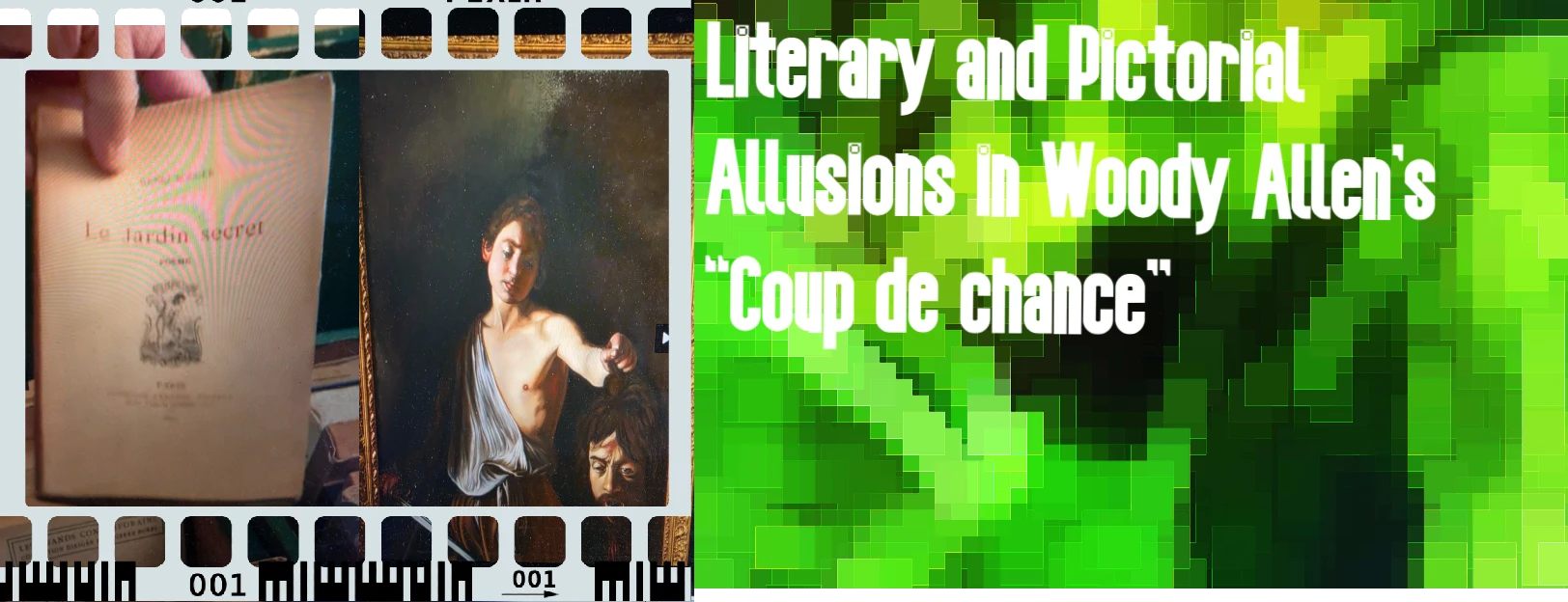
Alain (Niels Schneider) — naturally a writer, intellectual and freelancer — has been in love with Fanny (Lou de Laâge) since secondary school. He idealises her, remembering her walking along a corridor in a black turtleneck with Anna Karenina under her arm. Here we encounter one of Allen’s much-loved references to Russian literature. During a walk together, Alain buys her a book in an antiquarian bookshop. The camera lingers on the volume for several seconds, long enough for us to read its title: Henri Rouger’s Le Jardin secret. It is a genuine rarity and an almost completely forgotten work; Fanny is clearly delighted by the gift.
Wondering how this book found its way into the film, I see two basic possibilities, with an entire spectrum of intermediate explanations between them. The first assumes a certain role for chance. While preparing the bookshop scene, someone from the crew may simply have asked for something rare and visually striking, or selected the book because of its intriguing title, Le Jardin secret. “The secret garden” sounds universal enough to suit a story about concealed love and the closed world of two lovers, even without any detailed knowledge of the poem itself. The second possibility is that Allen or someone on the crew knew Rouger’s work, or had previously encountered the book, and consciously decided that this title and this particular volume fitted the film’s story. Without statements from the filmmakers, it is impossible to determine which explanation is correct. What remains certain is that we are dealing with an author who is now almost entirely forgotten. I found no entry devoted to him in either the French or English Wikipedia — only a modest Wikidata record. The poem itself, published by Alphonse Lemerre in 1893, has survived mainly in library catalogues and digitised scans.
I am not a professional philologist, but an ordinary reader — the person for whom literature ultimately exists. I therefore have no intention of copying encyclopaedic definitions of the movements and tendencies of nineteenth-century French literature, or of forcing Rouger into one of them, because without the appropriate training this would sound unconvincing and unnatural. Nor is my French good enough for me to read such an old and linguistically demanding poem with complete freedom.
I found a copy on archive.org, and several details about the author on the excellent website https://www.anthologialitt.com/, created by genuine enthusiasts of dusty and forgotten books. Its authors describe Rouger as a post-Parnassian, and in this matter I shall trust these two French writers more than my own uncertain knowledge of the subject.
To understand the poem’s structure and essential content, I used a digital scan of the 1893 edition together with online language tools, preparing a working prose translation and comparing it with the original. The aim of this brief investigation is therefore not a complete literary analysis, but an attempt to determine whether Le Jardin secret has a deeper relationship with the film’s plot or appears merely as a loose, perhaps accidental prop. I shall try to pass the poem through the filter of modernity, together with all its various “isms” — those that existed, those that exist and those that may still come. A simple schoolroom summary of the plot is no longer sufficient today.
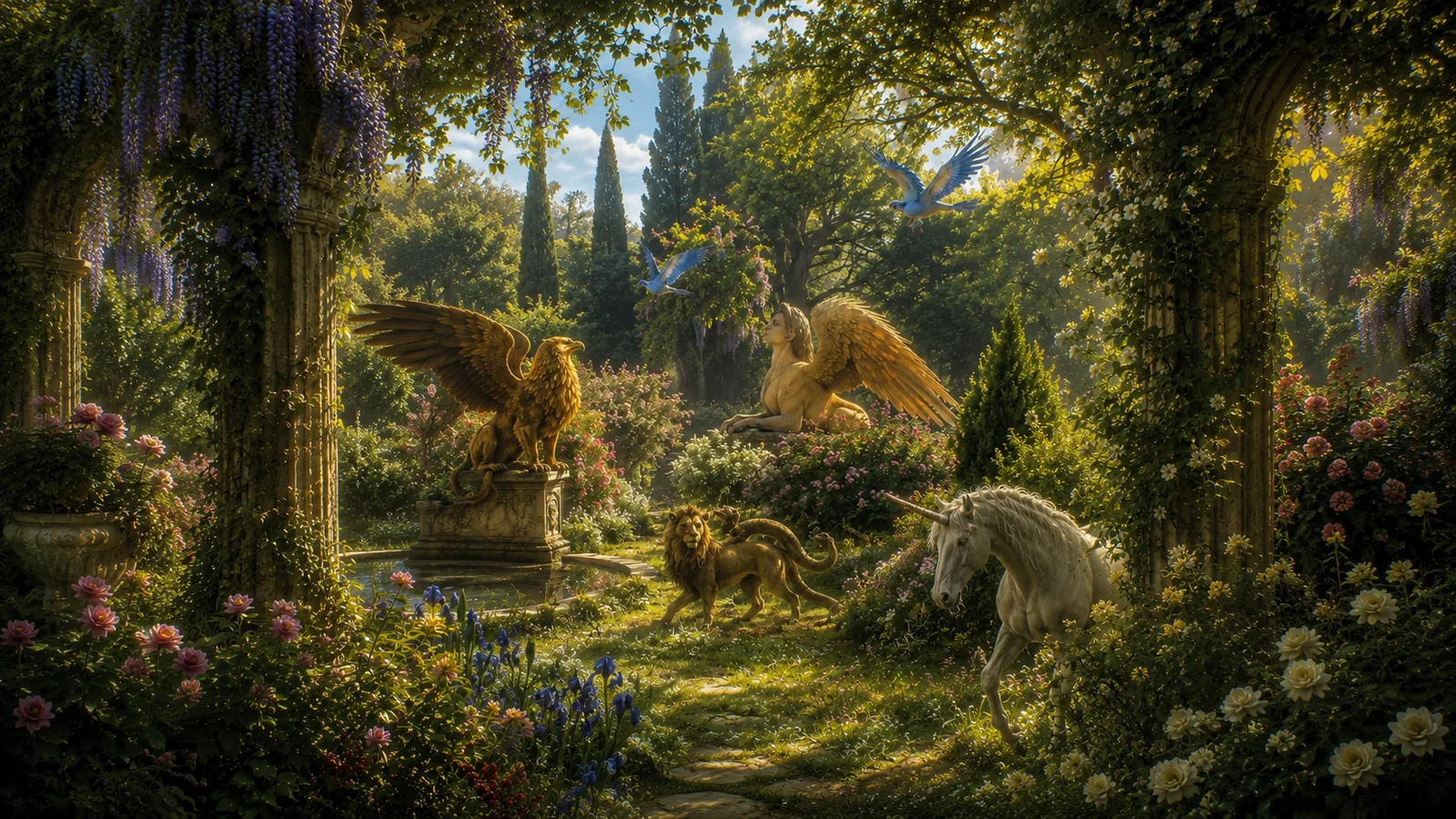
Having familiarised myself with its content, I would say that the author shows no mercy either to himself or to the potential reader. Thematically, the poem circles around the desire for a love both ideal and physical, leading us through dreamlike visions that resemble a serious narcotic trance. The forest pulsates, animals fall into an erotic frenzy, time and space disintegrate, and from the Beloved’s grave grows a garden encompassing every climate zone, season and mythological creature. The claim that this poet may have been a precursor of psychedelia is my personal contribution to literary history ;) The poem is beautiful and at the same time wildly naïve — beautiful in its abstraction and precisely in that naïveté. Read literally, however, it may prove difficult for the contemporary mind to endure, riddled as it is with intellectual stimulants and Anthropocene distractions. The accumulation of metaphors, comparisons and other poetic devices — whose names I do not even know — can become so overwhelming that the poem may be read in two ways: quickly, retaining above all its general impression, or very slowly and analytically, searching for meanings, contexts and successive layers. In short, it is completely out there, and individual stanzas could now serve as excellent prompts for AI-generated psychedelic images.
To become serious for a moment and give the poet the respect he deserves, it must be said that the entire work was composed in terza rima, the demanding chain-rhyme form made famous by Dante himself. It reveals enormous respect for poetic craftsmanship. Maintaining such a rhyme scheme over dozens of pages would presumably be difficult after mushrooms, which in this context frightens me even more :) The poetic engine is running at maximum speed. From the biographical fragments and the poem itself emerges an image of Henri Rouger as a rather melancholic man, absorbed by insoluble questions about the meaning of life and probably not especially happy. The times are fast, so I chose the first of the two reading methods described above: an attempt to capture the overall impression, leaving detailed metrical analysis to academic scholars.
But perhaps none of this is quite so decisive, because the reception of poetry may depend on apparent trivialities: whether we read in the morning or evening, full or hungry, hungover or sober, loved or longing for love, tired or rested, in a garden or on a beach. The same work may speak to us completely differently under different circumstances — and that is precisely the magic of poetry. Very well, but let us return to the fundamental question: what does Rouger actually do for the film? Unfortunately, the answer does not present itself immediately, which is slightly troublesome for a lazy fellow like me, because it forces me to consider two possible paths of interpretation.
The poem corresponds with the film in the same way that many other literary works might. We find within it the universal motifs of idealisation, love, desire, solitude, mystery, death, memory, loss and the wish to preserve the beloved forever. All of them also appear, in different configurations, in Allen’s film, but they are so deeply rooted in the history of art that they have formed part of its shared language since antiquity. From this perspective, the selection of the poem may have been either deliberate or accidental — in either case, the book fits the story perfectly. The second interpretation concerns the title itself, Le Jardin secret. “The secret garden” is a beautiful, capacious phrase, open to an almost unlimited number of interpretations: it may signify hidden love, a space of intimacy, the lovers’ secret, a person’s inner world or an area inaccessible to others. Understood this way, the book may have been selected without any deeper knowledge of its content — not entirely by chance, but because of the title itself and the associations it evokes.
Should anyone wish to look into the poem itself and experience its language, I certainly have no intention of discouraging them. For orientation, I quote below three stanzas from the second part of the poem in the original, lacking both the audacity and the competence to attempt a literary translation:
Ô chaleur ! Ô lumière ! Heure où l'été flamboie !
Épanouissement des radieux midis !
Ô claire effusion de soleil et de joie !
C'est midi ! c'est l'été ! Je brûle et resplendis.
Un grand jardin m'entoure, immense et solitaire,
Pareil aux lieux rêvés des anciens paradis,
Un jardin de silence en un lieu de mystère...
Et le jardin rayonne en sa sérénité
Comme un jardin claustral au fond d'un monastère.
The second intriguing allusion, which I was pleased to recognise, is a sonnet by Stéphane Mallarmé, quoted in one of the conversations, about a swan trapped in ice. This time we are dealing with a far better-known poet, firmly present in literary history and translated many times. Mallarmé was one of the representatives of French Symbolism.
In this instance, the poem’s content corresponds much more clearly with the film’s plot. Almost from the beginning, Alain feeds Fanny poetry, restoring something she had managed to forget within a marriage built on social position and material security. The poems open before her a space of abandoned desires and remind her of a world she once needed. As though sensing her condition, Alain chooses a sonnet about a magnificent swan imprisoned in a frozen lake, remembering flight but unable to break free from the ice. It is difficult not to see Fanny in this image: a woman living in beautiful and comfortable surroundings, yet frozen within a reality that does not allow her to take flight.
Since I was unable to locate Mieczysław Jastrun’s Polish translation, I shall reproduce my own working paraphrase below. It makes no claim to the status of a literary translation; the English text presented here is a rendering of the Polish paraphrase prepared for this article.
Will this day, in its full-blooded, immaculate beauty, allow us, with an ecstatic beat of wings, to shatter this frozen lake of unfulfilled flights, forgotten beneath its crust of ice?
The swan of old remembers flight.
Beautiful, yet one that falls silent,
for it did not surrender its soul to the Muses.
Magnificent, yet freeing itself without hope.
With a shake of its stately white neck it tries to break free from the shackles
of a nature not its own,
but not from the very earth in which it has taken root.
The shadow which its pure radiance lends this place
freezes in the cold dream of scorn
that the Swan assumes amid its futile exile.
The third allusion I encountered is a representation of David with the Head of Goliath, appearing in one scene and clearly pointing towards Caravaggio. The motif is sufficiently iconic and suggestive to be recognised without difficulty by any viewer even slightly familiar with art. This time, its correspondence with the film is strong and legible. To describe the details would reveal too much of the plot, but it will hardly count as a major spoiler to say that a murder also occurs. Not everyone here is as beautiful and ethereal as the apparitions from Le Jardin secret, because the effect would become insipid — and the director knows this perfectly well. Allen has repeatedly known how to disarm violence with humour, leaving the viewer uncertain whether to laugh or be afraid :) This time the joke rests partly on a physiognomic stereotype: the professional killer turns out to be an unattractive, low-browed fellow, certainly cast or made up with precisely this effect in mind. Deciphering this suggestive condensation of cinematic content within a single image becomes an enjoyable intellectual exercise. Who is David here, and who is Goliath? Let each viewer decide after watching the film.
What, then, do Rouger, Mallarmé and Caravaggio give the film? Each allusion works differently. Le Jardin secret remains the most mysterious — it may be a deliberate commentary, an intuitively selected title or simply an extraordinary object found in an antiquarian bookshop. Mallarmé’s sonnet describes Fanny’s condition far more directly: beautiful as a swan, yet imprisoned in a world of abundance from which she cannot take flight. The representation of David with the head of Goliath, meanwhile, becomes an artistic shorthand for the film’s dark axis, while subtly opening another space of interpretation.
One may watch Coup de chance as a romance and a crime story without recognising any of the works invoked. But one may also pause for several seconds over the shot of the book, listen closely to the quoted poem or look at the severed head in the painting — and discover a passage into the film’s hidden layer. Perhaps this is its true secret garden. One need not enter it in order to enjoy the story, but once the gate has been found, it becomes clear that behind the apparently simple narrative extends an entire world of literature, painting, love, death and chance. In other words: a Woody Allen film — with all of Allen inside it.