Arvo Pärt at the Odeon of Herodes Atticus
A report from an Arvo Pärt concert at the Odeon of Herodes Atticus in Athens — a text about music, place, the ancient audience, history and a late-night walk to Exarchia.
Posters, the Acropolis and a chance discovery
Although I had not planned it from the beginning of my stay in Athens, posters announcing some major artistic event seemed to be attacking me from every direction. In passing, I managed to grasp only that it was a festival stretched over a longer period, made up of numerous concerts, performances and live art events.
On my last day, as planned, I went to the Acropolis. On my way back, descending along one of the paths down the hill, I suddenly caught sight of the word “theatre” out of the corner of my eye. I stopped for a moment and realised that I was standing at the entrance to the Odeon of Herodes Atticus.
At that point, all my earlier associations with the place came back to me. Over the years, first while browsing the music press and listening to the radio, and later while roaming the internet, I had repeatedly come across announcements and reports: someone important had appeared at the Odeon in Athens, some star had played a concert beneath the Acropolis, some artist had recorded a live album there. “At the Odeon this”, “at the Odeon that” — the name of the place kept returning like a mark of prestige.
Artists from a very broad spectrum of the arts had performed there: classical music, theatre, performance, rock and pop. Over time, I began to think of the Odeon of Herodes Atticus as one of those places that give an event status simply by hosting it — rather like Madison Square Garden or the Royal Albert Hall. The difference was that here, behind the stage, stood not the legend of modern show business, but stone, the Acropolis and almost two thousand years of history.
Only later, after leaving the metro, did I stop for longer in front of one of those posters and finally check what it was actually advertising. It turned out not to be a single concert series or a collection of unrelated events, but the Athens Epidaurus Festival — one of the most important Greek festivals of the performing arts.
It has existed since the mid-1950s and from the outset has been associated with the Odeon of Herodes Atticus, whose location at the foot of the Acropolis gives its events a particular dimension. The festival programme includes music, theatre, dance, opera, performance and projects that resist easy classification. Within it, the Odeon functions as a stage on which very different artistic languages can meet: from classical and contemporary music, through large-scale spectacles, to experimental stage works and concerts by artists known far beyond Greece.
Only then did I understand that the posters I had previously passed with a degree of indifference were not simply advertising “something cultural in Athens”. They were announcing a festival during which, for several summer months, the city turns into an extended map of stages.
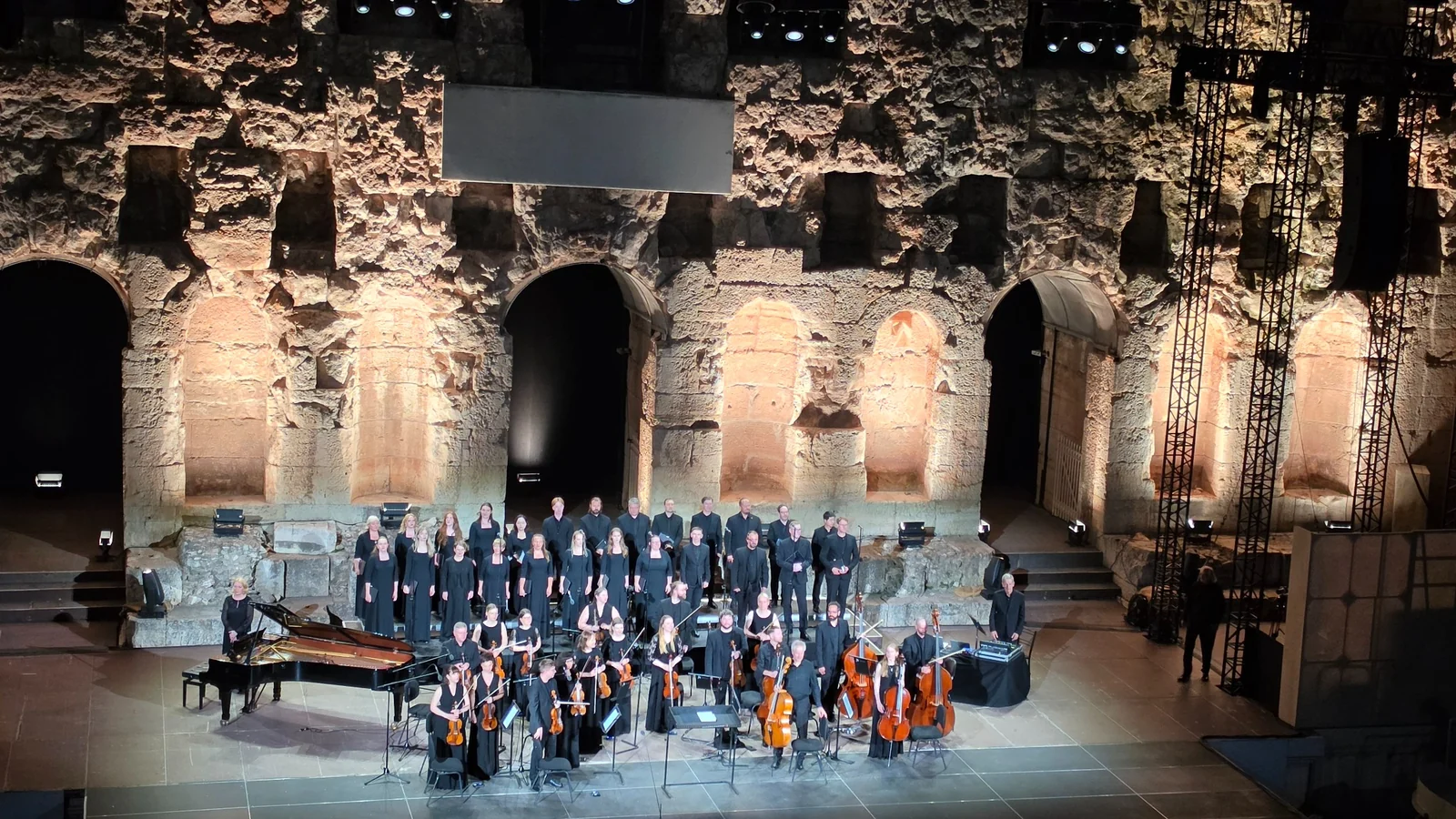
For 15 June 2026, a concert by the Estonian Philharmonic Chamber Choir and the Tallinn Chamber Orchestra, conducted by Tõnu Kaljuste and devoted to the music of Arvo Pärt, had been scheduled. Since I already knew some of the Estonian composer’s music, the decision came quickly: I bought a ticket. I thought that hearing Pärt at the Odeon of Herodes Atticus, beneath the Acropolis, might be an experience that would never come again.
The Odeon of Herodes Atticus
You enter the Odeon of Herodes Atticus by climbing stone steps from Dionysiou Areopagitou, the broad pedestrian avenue running at the foot of the Acropolis. The approach itself is impressive: among trees and pale stone, a massive Roman structure gradually emerges, resembling the entrance to an archaeological monument more than to a contemporary concert hall.
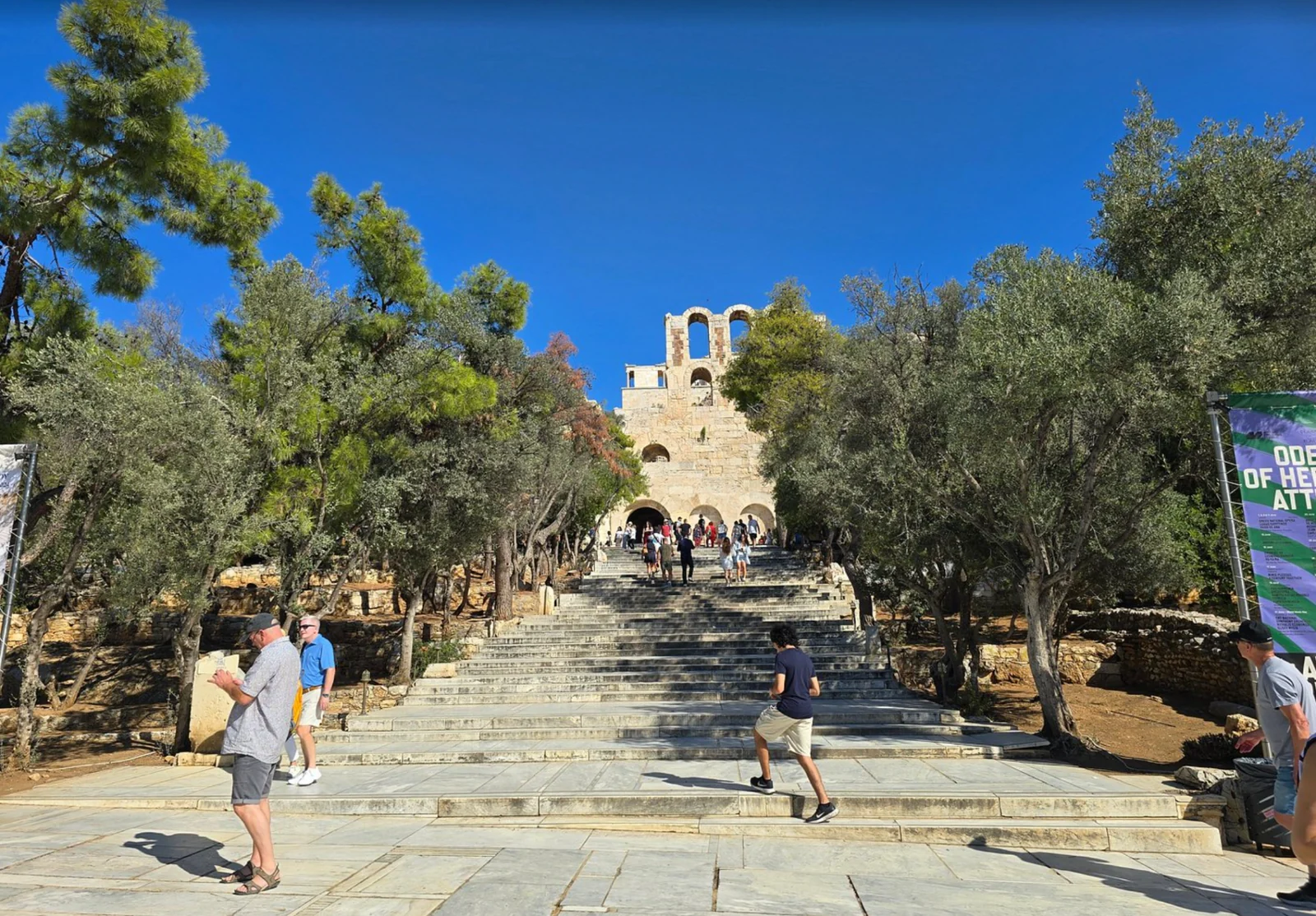
The Odeon of Herodes Atticus is a Roman building, founded in the second century CE, between 160 and 174, by Herodes Atticus — an extraordinarily wealthy Athenian aristocrat, rhetorician and benefactor of the city. It was built in memory of his wife, Regilla. On the one hand, it was a public gift to Athens; on the other, a private monument of mourning inscribed into the monumental architecture of the city.
A small but important digression is needed here. When we say that Herodes Atticus “built” the Odeon, we are of course using shorthand. No pharaoh raised a pyramid with his own hands, no emperor personally set up columns, and no wealthy patron chiselled the stones for the temple he financed. Great buildings usually preserve the names of their founders, rulers and benefactors, far less often those who actually carried, cut, worked and laid the stone.
It would therefore be more precise to say that Herodes Atticus funded the Odeon: he provided the money, prestige and political and social meaning of the undertaking. The building itself, however, was the work of an entire human infrastructure — craftspeople, stonemasons, labourers, supervisors and all those anonymous workers whom history most often turns into silent background figures behind the names of the powerful. Marble remembers the patron, but other hands bore its weight.
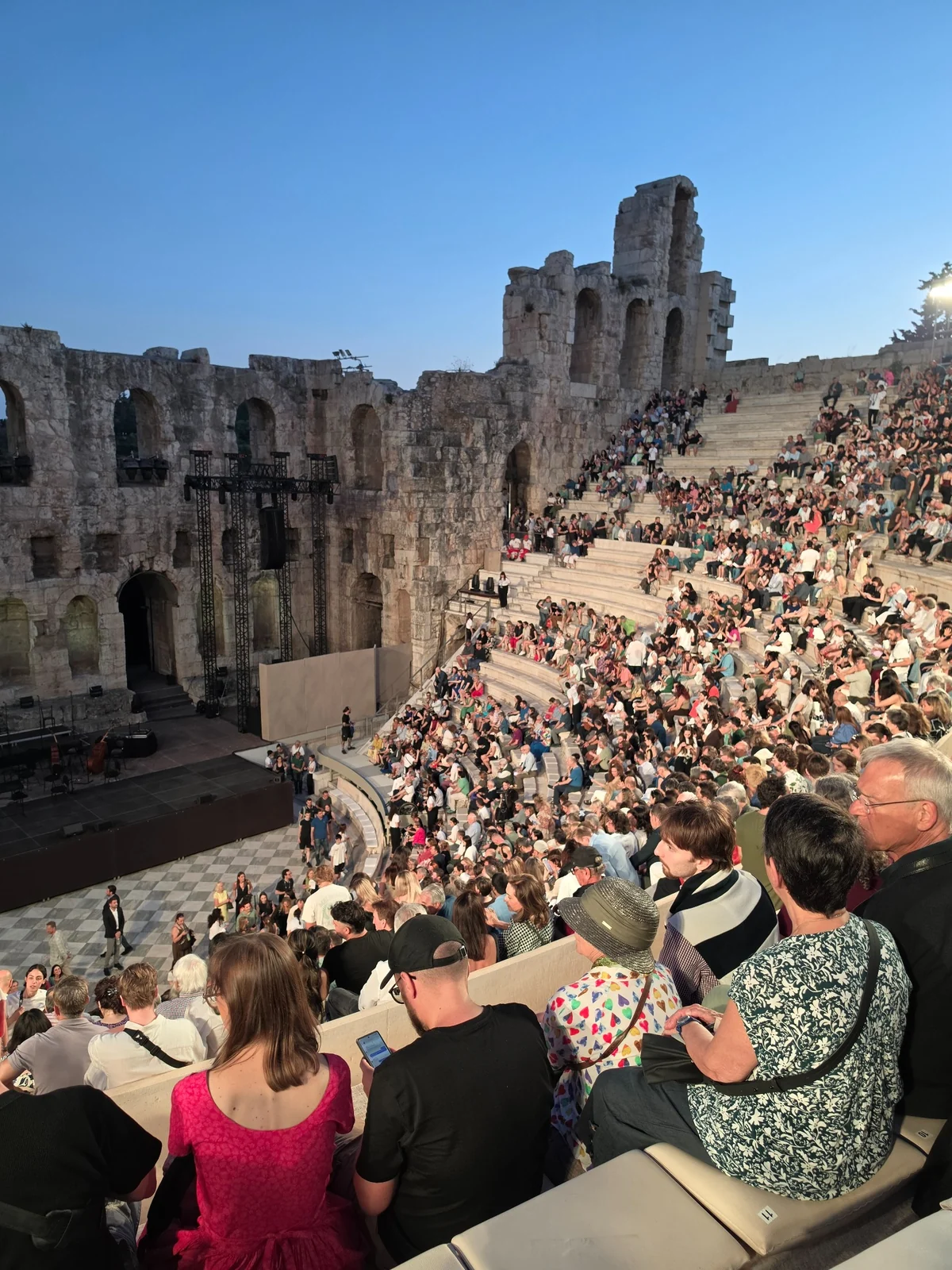
The Odeon itself is overwhelming. Above all, it is enormous: it could hold around five thousand spectators, and you can genuinely feel that scale. It is an excellent venue for a medium-sized concert, but by the standards of an ancient city it was almost monumental.
One must remember, however, that in the Greco-Roman world monumentality was part of the language of architecture. A person standing before temples, theatres, porticoes or walls was meant to feel their own smallness in the face of the power of the gods, the city, the benefactor or the empire. The Greeks understood the force of this effect extremely well, while the Romans adopted it, developed it and carried it to an even greater scale. The Odeon of Herodes Atticus, although rooted in the Athenian landscape and the Greek theatrical tradition, already belongs to that Roman world of monumental gesture.
If the Odeon of Herodes Atticus held around five thousand spectators, then in the reality of Roman Athens this was an impressive capacity. We do not know the exact number of inhabitants in the second century CE, but cautious reconstructions suggest tens of thousands rather than a vast metropolis. A full Odeon therefore meant the gathering of a significant part of the urban public — not all of Athens, but enough people for such an event to have not only artistic, but also social and symbolic importance.
Reaching the sector marked on the ticket is not entirely straightforward, however. The marble paving can be slippery, the gradient of the auditorium is steep, and there are few handrails. This is probably a consequence of the nature of the place: every contemporary intervention has to yield to the ancient layout and form of the building.
For me, as a person with a disability, these “lack of conveniences” posed a certain challenge. Fortunately, attendants were stationed by each section of the auditorium and were ready to help when needed. It is worth noting this detail, because in a place like this the monumentality of history very quickly meets an entirely practical question: how does one safely reach one’s seat? :)
The imagined audience of the ancient theatre
Once I had taken my seat, my imagination began to work. Looking at the stone rows of the auditorium, the stage and the thickening crowd, I started to wonder what similar events might have looked like in antiquity…
Human beings have needed art for a very long time — to participate in it, to encounter it and to create it. From the paintings at Lascaux to ancient theatres, the same need keeps returning: to step outside everyday life and give experience form, rhythm and meaning. It was no different in second-century Athens, although the city was by then under Roman rule and no longer possessed its former political autonomy.
Athens nevertheless remained a place of enormous symbolic prestige. For educated Roman elites, it was the space in which the most important models of art, philosophy, rhetoric and civic life had been born. The Greek theatrical tradition was adopted by the Romans with fascination, but — as with every cultural transfer — it underwent transformations, simplifications, adaptations and the influence of the receiving culture.
Education through art was an important part of Greek paideia, the ideal of comprehensive human formation. It was not only about acquiring knowledge, but about shaping character, the body, taste, memory and the manner of participating in communal life. A particular place within this system belonged to mousikē — a concept much broader than what we mean by “music” today. It included music, poetry, singing, dance and various forms of performance.
The Greeks believed that music acted directly upon the soul and could shape ethos, the character of a person. It was therefore not merely entertainment or a separate artistic discipline. It formed part of moral, intellectual and spiritual education. Through songs, rhythm, stories and performances, memory of the past was transmitted, along with patterns of behaviour and images of gods, heroes and the community.
In the second century CE, Athens remained under Roman rule, but culturally it still attempted to play the role of guardian of the old Greek world. This was the period of the so-called Second Sophistic — a revival of Greek rhetoric, education, style and fascination with the classical past. For educated elites, Greek tradition was not merely a dead inheritance, but a language of prestige. People spoke, wrote and performed in ways intended to summon the former greatness of Hellas, even though political reality was now Roman.
Simon Goldhill, writing about rhetoric and the Second Sophistic, draws attention to the enormous role played at that time by education, public speaking and deliberate references to the classical past. The elites of the Greco-Roman world did not simply admire ancient Greece — they performed it, quoted it, stylised themselves through it and used it as a sign of their own education and social position.
And here we reach an important issue: the status of the artist — or, more broadly, the performer — in the Greco-Roman world. This was not a single social group. People who appeared in public came from different classes, performed different functions and enjoyed very different levels of prestige.
At the top stood rhetoricians and sophists: often members of urban elites, educated over many years, and born into families with wealth, contacts and appropriate cultural resources. To us they sound like intellectuals, but in the second century CE they were also performers. Public declamations, rhetorical displays and lectures could become major urban events, attracting audiences not only through their content, but also through the speaker’s style, gesture, voice and personality.
In the era of the Second Sophistic, the spoken word was therefore not merely a tool of education but also a spectacle. The rhetorician performed before an audience much like an actor or musician, although his social status was usually considerably higher. Thomas A. Schmitz, describing the culture of performance in Greek cities under the Antonines, notes that sophistic declamation belonged to the most spectacular and prestigious public events of the time.
Lower in this hierarchy, though professionally very important, were festival performers: musicians, actors, singers and dancers organised in associations, travelling between cities of the Greco-Roman world and taking part in successive festivals, competitions and spectacles. The situation of mimes, dancers and performers in popular theatrical forms was different again. Here one encountered more people of lower status: freedmen, enslaved people or performers associated with forms of entertainment regarded as morally suspect.
This is where the entire ambiguity of the actor’s status becomes visible. An actor could be famous, attract crowds, earn money and inspire admiration, yet in the Roman world the very act of placing one’s body, voice and emotions on public display could be regarded as morally suspicious. Many stage performers had low legal and social status, often associated with the category of infamia. At the same time, some achieved popularity and wealth. Society needed them, admired their skills and yet could also despise them.
This tension sounds surprisingly contemporary. The artist is useful when expected to adorn a celebration, provide emotion, entertainment or prestige. Yet as soon as the artist begins to be perceived as someone carrying out real work — work that requires security, payment and social recognition — suspicion immediately returns: is this really work, or merely a whim, a game, a luxury or a private indulgence?*
*This mechanism became particularly visible in Poland in 2026 during debates about the professional status and social security of artists. Whenever the real working conditions of creators are discussed, it quickly becomes clear how easily admiration for art turns into disregard for the people who make it.
The classical canon remained important in this period: Aeschylus, Sophocles, Euripides, Aristophanes and Menander. This does not mean, however, that the audience of Roman Athens simply watched the same plays in unchanged form, exactly as they had been staged in the fifth century BCE. Ancient texts and myths increasingly functioned through adaptation: individual motifs, scenes, conflicts or characters were selected and then developed into new forms of spectacle involving music, chorus, dance and striking stagecraft.
Pantomime was particularly important — not in the modern sense of “a person pretending to touch an invisible wall”, but as one of the great theatrical and dance forms of the Roman Empire. A single performer, supported by music and a chorus, could enact entire mythological sequences, successively embodying different characters. It was a theatre of the body, mask and gesture.
Alongside pantomime there was mime — a more popular, everyday, comic, often obscene and urban form. Its subjects included betrayal, adultery, domestic quarrels, eroticism, fraud, greed, parody of tragedy and scenes from the lives of the lower classes.
Such events were not merely innocent entertainment. They also served a social and political function: they channelled the emotions of the crowd, gave poorer people a share in the city’s celebrations, and allowed elites to present themselves as benefactors. Art, music, myth, ritual and public generosity worked together as a mechanism of stabilisation. They did not abolish inequality, but helped to make it bearable. A person might sit far from the seats of honour and yet still feel, for a moment, that they were participating in the greatness of the city.
In this sense, the famous Roman formula panem et circenses — “bread and circuses” — captures one aspect of this order well. It was not only about amusing the populace. It was about producing a sense of participation, releasing tensions and reinforcing hierarchy in such a way that even those occupying worse seats could briefly feel part of a larger whole.
The audience of the Odeon was not a homogeneous “cultural public” in the modern sense. On the stone benches, the city and its hierarchy were mapped out: priests, officials, benefactors and elites at the front; farther back free inhabitants, visitors, educated people and ordinary participants in urban life; and in less prestigious places, people of lower status, perhaps including enslaved people, freedmen and some women. The event was public, but it did not abolish hierarchy — the theatre allowed it to be seen.
The scale of the Odeon suggests that ancient stage art was not an exclusively elite form of entertainment. A building capable of holding around five thousand people could not have served only a narrow circle of aristocrats, rhetoricians and officials. It attracted a much broader audience: free inhabitants of the city, visitors, educated and uneducated people, festival participants, the curious, and probably also servants and people of lower status.
And the tickets? Here one has to remain cautious. For the second-century Odeon of Herodes Atticus, we have no reliable price list or precise information about rules of admission. Earlier Athenian tradition knew fees for theatre seats, and there is also mention of two obols, but one should not mechanically transfer this to the Roman Odeon of Herodes Atticus. It is possible that at some events tokens or other forms of controlling admission and seating were used, especially where social status and the right to a better place mattered.
It seems more likely, however, that the system did not work like a contemporary commercial concert with a simple division into more expensive and cheaper tickets. Events of a festive, civic and festival character may have been publicly financed or supported by the generosity of elites, while access could have been broad without necessarily being equal.
Around such events there must also have existed a secondary, less elevated circulation of the festival: sellers of food, wine, fruit, nuts, small cult objects and souvenirs. Where people officially spoke of music, gods, poetry and the prestige of the city, the ordinary mechanism of the crowd also operated alongside it: someone was hungry, someone wanted to buy something, someone wanted to earn money, someone sold things useful, sacred or entirely unnecessary.
People sitting there, sometimes in shabby tunics and leather sandals, dishevelled, coarse, noisy, occasionally nervous, jostling, pushing and fighting for better seats — side by side with elegant dignitaries in the VIP boxes, adorned with the signs of power, pompous, self-important and patronising. Loudly commenting, reacting, shouting in admiration or disapproval, gesticulating, arguing, laughing, debating!
This was the kind of theatre I imagined while sitting there that evening…
Pärt beneath the Acropolis
I have attended hundreds of concerts and I know that music itself can never truly be conveyed in words. I will not pretend that sound can be translated into description without loss. One can record only the stage directions: the place, the light, the tension before the first note, one’s own concentration and what remains after the last. Music is a direct experience — it happens in something difficult to name. Words can only circle around it, indicate a direction and perhaps describe the conditions of listening. Anyone interested will easily find recordings of Pärt.
To say that Arvo Pärt’s music suited the place perfectly would be a truism. It is music of silence, silence that plays; of empty spaces that also play, giving breath and carrying delicate, ethereal, barely audible instrumental sounds. It is focused, contemplative, imaginative, relaxing, spacious music, painted with a broad and slow sound that neither irritates nor hurts. It soothes. It is music entirely outside contemporary, noisy, rushing time. It unfolds slowly, lasts a long time and departs without haste.
Arvo Pärt is not a composer whose music is best described through the quantity of notes. Rather, through what remains between them. The Estonian composer, associated with contemporary music, developed his own language known as tintinnabuli — based on simple harmonies, repetition, silence and almost ascetic concentration. It is not music of effect, but of waiting; it builds its monumentality gradually, through successive layers placed one upon another.
The programme for the evening included five works by Arvo Pärt: Für Lennart in memoriam, L’abbé Agathon, Stabat Mater, Magnificat and Te Deum. The first part ended with Stabat Mater, followed by an interval; after it came Magnificat and the monumental Te Deum. All the works, together with descriptions, original texts and translations, can be found on the website of the Arvo Pärt Centre:
The verbal layer of the works is based on old Christian, liturgical and hagiographical texts, full of archaic vocabulary rarely used today. During the concert, the original text and an English translation could be followed on screens, but because of the way the musical narrative unfolds, understanding them was not always easy. Even without music, these texts are so deeply rooted in the European religious and artistic imagination that it is worth pausing over a few selected phrases, old forms and words.
Für Lennart in memoriam
Thy calm haven
- thy is the archaic possessive form of your
- in religious language it often refers to God
I cry unto Thee
- thee is the archaic object form of you
- unto is an archaic form of to
yet Thou, O Lord Jesus Christ, Who art...
- thou is the archaic subject form of you
- art is the archaic form of are
Stabat Mater
sole-begotten One = the only-begotten One, the only Son
scourges rent = torn by scourging
- rent comes from the verb rend, “to tear”, and has nothing to do with the noun meaning payment for accommodation
hath = archaic form of has
shalt = archaic form of shall or will
Magnificat
Adonai
- a Hebrew title for God or the Lord
- often retained in its original form in liturgical texts
Te Deum
Vouchsafe, O Lord = graciously grant, O Lord
- vouchsafe is now a very rare archaic word, used mainly in religious texts
Lord God of Sabaoth = Lord God of Hosts
- Sabaoth comes from the Hebrew word for “hosts” or “heavenly armies”
- it survives in the traditional formula “Lord God of Hosts”
Exarchia after the concert
Leaving the theatre late in the evening, and knowing that it was my last day in Athens and that I still had not had enough, while one small point concerning nightlife remained unchecked :), I made a last-minute trip to Exarchia, an artistic district which, fortunately, was not far from my hotel.
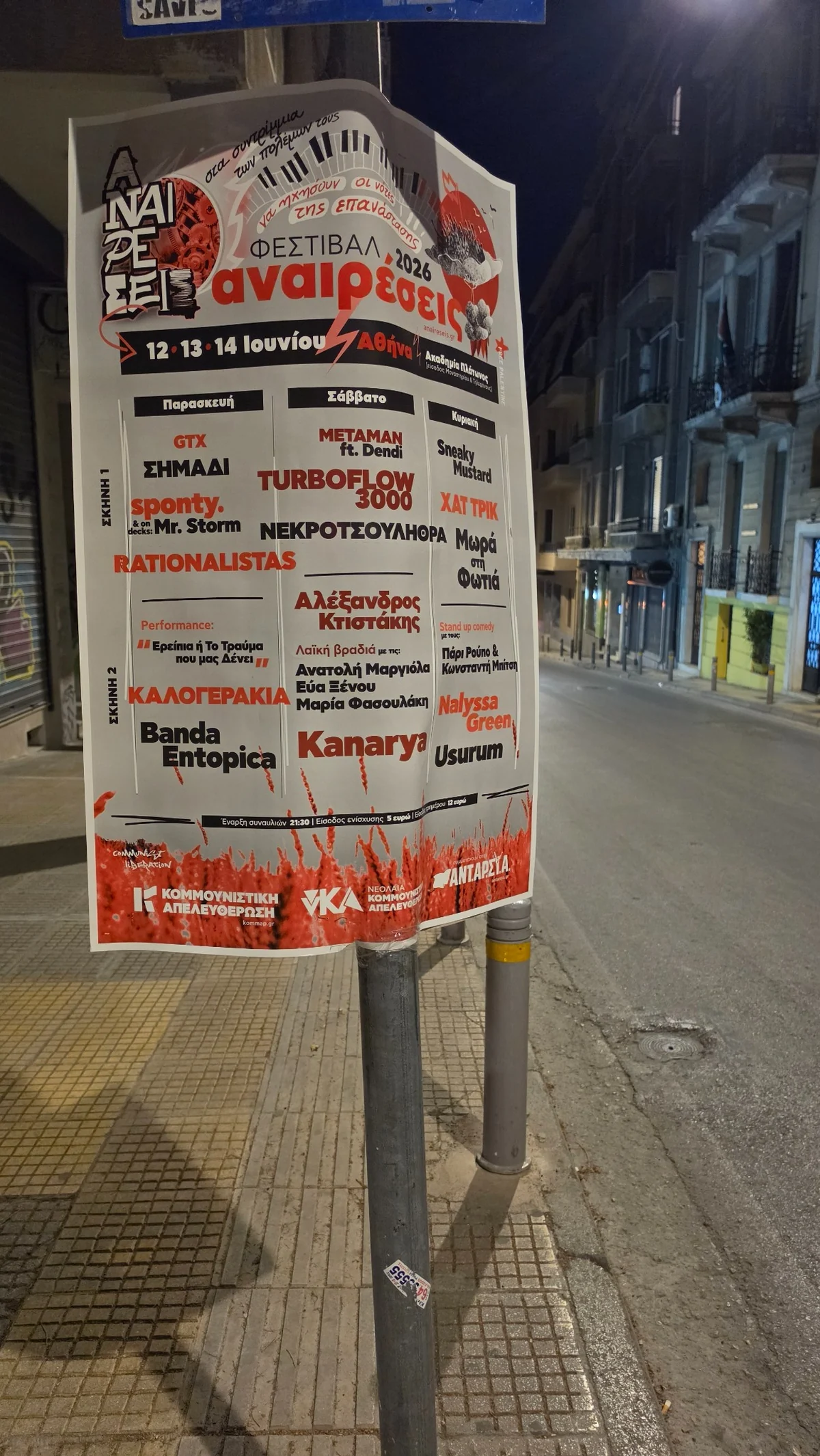

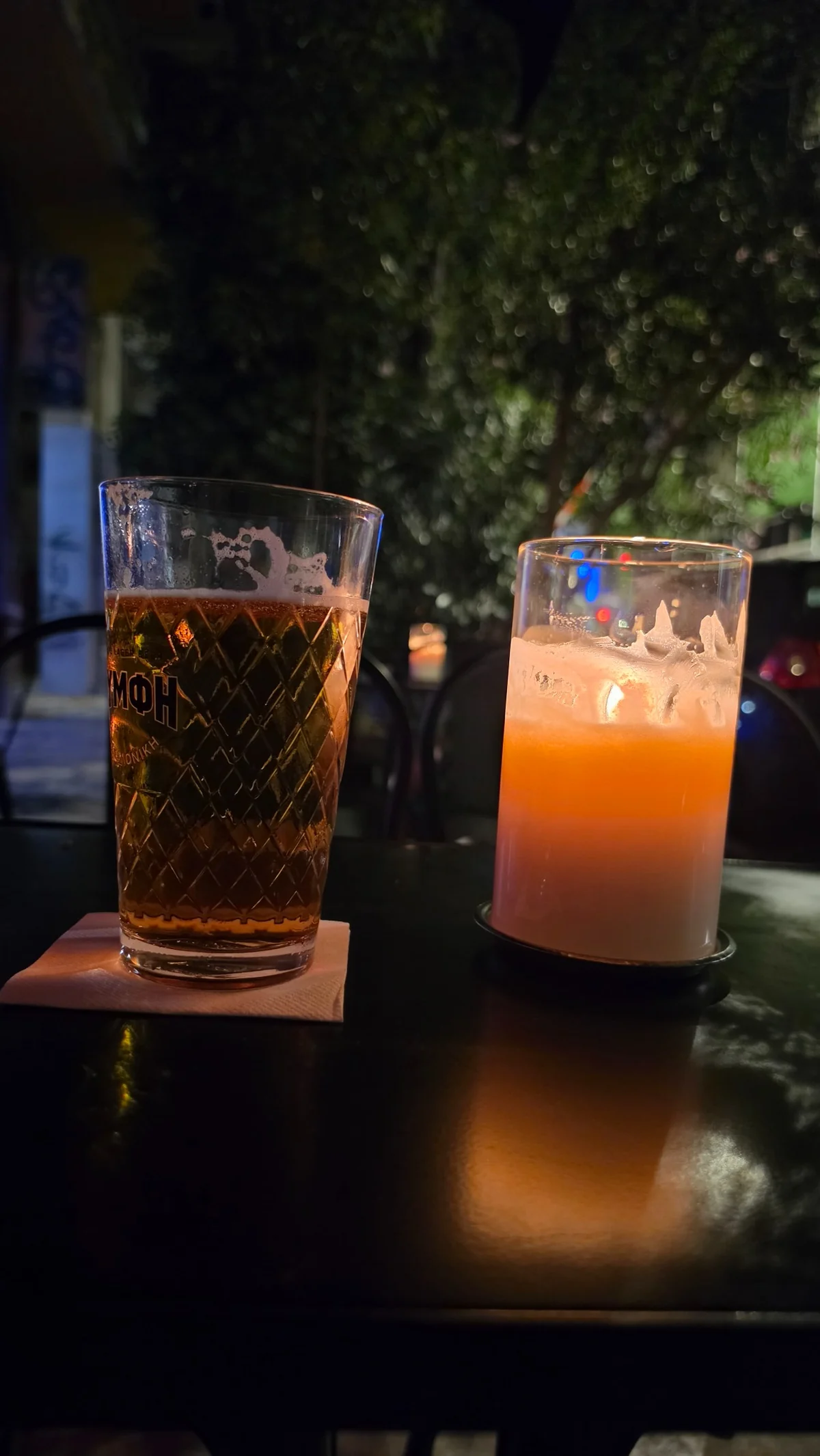
The abrupt passage from the ancient theatre, dressed in carefully ironed shirts and filled with solemn words, into a world of culture presented in a less elevated setting might have been problematic or incomprehensible to some people. Not to me. Raised on punk, walking through a district full of posters, clubs and colours, I repeatedly found surroundings that felt familiar and welcoming. Sitting down for one final beer in Athens, I tried to gain some distance and, in a sense, digest the events of the evening.
Antiquity, hypnotic and meditative Pärt, and punk. Three vast areas of culture, all equally valuable, important and necessary — together forming the shape and image of the contemporary world. Layering over one another, permeating one another, constantly drawing upon their accumulated heritage and appearing in different forms throughout history. That evening I saw what I had always intuitively sensed: there are no natural boundaries in art — it is a unity. Not alternative, not mainstream, not counterculture, not high or low art, but simply art. One art for everyone, like the art that existed in distant times at Lascaux, when all could look at it, admire it and draw from it regardless of their status within the social group.
And if Witkacy’s thought may be invoked here, then the paradigm of an immense, inclusive art, treating its material according to a timeless universalism of values, may be the appropriate measure.