My Brilliant Friend
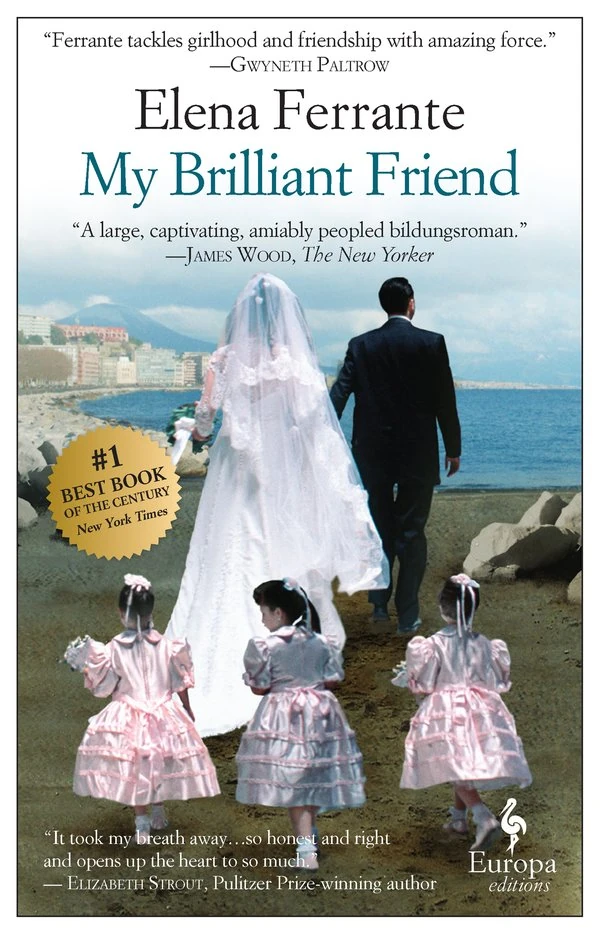
My Brilliant Friend is an ordinary and utterly mediocre book. And although it comes recommended on the cover by Jonathan Franzen himself, there is an abyss between these two writers in terms of literary craft — they simply aren’t in the same league. All that rapture and those high rankings on the lists compiled by various illustrious bodies are, of course, a joke. Once again, they show that mainstream recommendations should not be taken too seriously, while real literary art, to paraphrase myself, lies hidden in a thicket of impenetrable undergrowth :)
We have two things to pick apart here: the story and the language. A story about the relationship between two little girls, children in a particular place and time. Each has a different character; they go to school, play, quarrel, discover the world, and have different dreams and ideas about the present and the future — and that is pretty much all there is to say about this book. Their lives are not exceptional in any way; they are as mediocre as the novel itself. You feel that plenty of such stories have already been written and read, and this is merely another variation on childhood, the environment someone grew up in, childhood fantasies and so on. And although the author tries to slip experienced trauma and pervasive violence beneath the surface, there is really nothing extraordinary about it. To some extent, it seems to stem from the narrator/author having little affection for the characters she describes.
The language, unfortunately, has no character whatsoever, nor any artistic or stylistic ambition. Just ordinary prose, sentence after sentence, without any verbal acrobatics or even a hint of genius. This is certainly no Nabokov, Bolaño or Mann :)
The book is clearly aimed at less seasoned readers. It is undemanding in style, smoothly written, and goes down without much resistance. In my mind’s eye, I see a reader coming into a library and asking the librarian for something popular, something that reads well and that “everyone recommends”. My Brilliant Friend fits that recommendation perfectly.
And although the story takes place in 1950s Naples, we never get a sense of the Naples we might have hoped to feel. I don’t mean the beauty of the city of which people say “see Naples and die”, but any feeling, taste or smell that would make us want to be there. I would go further: there is precious little even of the Italian character we may carry around in our imaginations. In this respect, the novel is utterly barren and could just as well take place anywhere else.
The book is written in the first person, and we don’t really know whether it is autobiographical or invented, or partly autobiographical and partly invented, as is usually the case — or even who wrote it. Elena Ferrante herself remains anonymous. If we assume that the novel is autobiographical, we get the impression that the author is not particularly fond of her characters, which would mean the neighbours and fellow locals from the period of her life she describes. Personally, I find that tone uncomfortable at times. Many great literary accounts of childhood, even a difficult, poor or brutal childhood, retain some element of magic, absurdity, tenderness, or at least the distinctiveness of a world seen through a child’s eyes. With Ferrante, there is none of that.
Here I am picking on an author again on this blog, but in this case, on one of the pages of her own novel, the author herself says that she feels no nostalgia for her childhood:
I feel no nostalgia for our childhood: it was full of violence. […]
A moment later, though, she says she does not remember ever thinking that the life she had was particularly bad, and adds:
[…] Life was like that, that’s all […]
And although, logically speaking, this last statement describes a child’s thoughts and feelings, it can still provide some basis for drawing conclusions about the writer’s actual views today.
Another observation: this novel from the second decade of the twenty-first century is entirely unfiltered by feminist theory. Matters such as the place, role and future of young girls and women in society, or sixteen-year-old girls being treated almost as ready-made wives, receive no commentary whatsoever — the narrative itself does not question these issues at all. As though it were enough to show them and assume they speak for themselves.
And my last, but least important, complaint about this book is its complete lack of humour! Perhaps not everyone needs it, but that sort of emotional balancing act really does light up the language.
But well, perhaps not everyone can do that :)